

Order cancellation
All orders can be cancelled until they are shipped. If your order has been paid and you need to make a change or cancel an order, you must contact us within 12 hours. Once the packaging and shipping process has started, it can no longer be cancelled.
Refunds
Your satisfaction is our #1 priority. Therefore, you can request a refund or reshipment for ordered products if:
- If you did not receive the product within the guaranteed time( 45 days not including 2-5 day processing) you can request a refund or a reshipment.
- If you received the wrong item you can request a refund or a reshipment.
- If you do not want the product you’ve received you may request a refund but you must return the item at your expense and the item must be unused.
We do not issue the refund if:
- Your order did not arrive due to factors within your control (i.e. providing the wrong shipping address)
- Your order did not arrive due to exceptional circumstances outside the control of unrivaledfinddepot.shop (i.e. not cleared by customs, delayed by a natural disaster).
- Other exceptional circumstances outside the control of https://unrivaledfinddepot.shop
*You can submit refund requests within 15 days after the guaranteed period for delivery (45 days) has expired. You can do it by sending a message on Contact Us page
If you are approved for a refund, then your refund will be processed, and a credit will automatically be applied to your credit card or original method of payment, within 14 days.
Exchanges
If for any reason you would like to exchange your product, perhaps for a different size in clothing. You must contact us first and we will guide you through the steps.
Please do not send your purchase back to us unless we authorise you to do so.
Instant download
Your purchase will be available to download once payment is confirmed.
Instant download items don’t accept returns, exchanges or cancellations. Please contact us if you have any problems







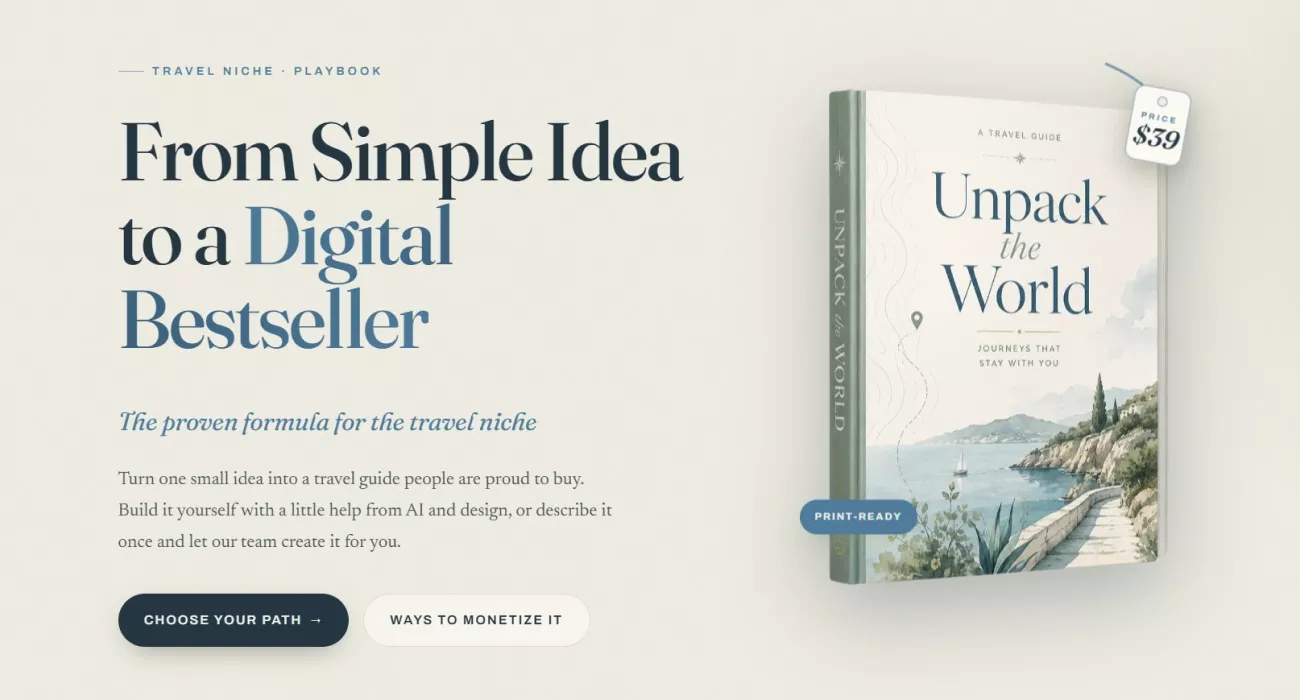
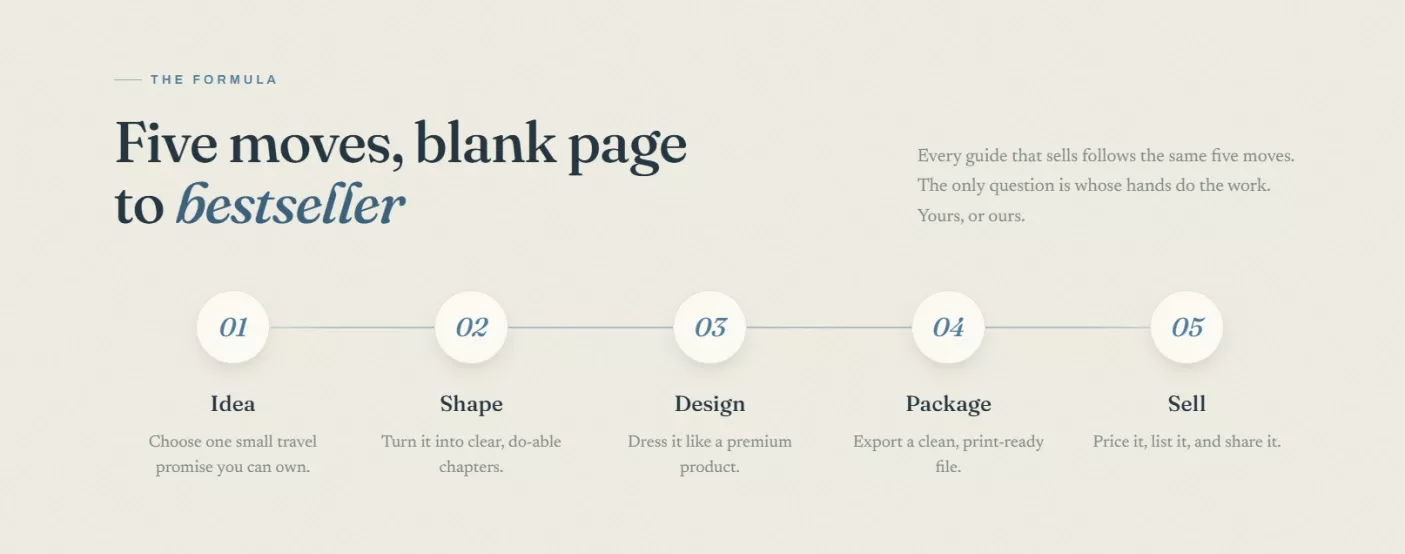
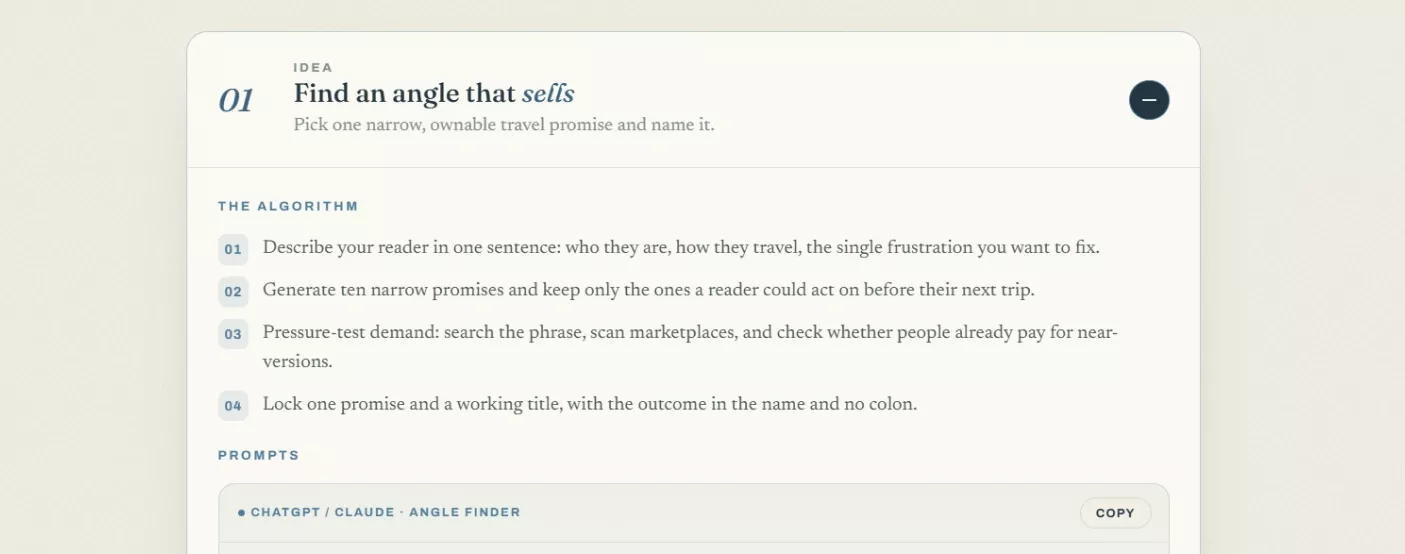
I'd been sitting on a travel idea for two years, scribbled in a notes app and never touched. I finally opened this and worked through Idea, Shape, Design, Package, Sell in a single weekend. The angle-finder prompt forced me to pick one narrow promise instead of the vague 'tips for travelers' book I kept imagining. By Sunday night I had a cover concept from the Midjourney prompt, a seven chapter outline, and a print-ready PDF under ten megabytes.Three people bought it before I'd even told my friends. The version of me from two years ago would not believe how little friction there actually was once I had the exact steps in front of me.
I liked that it forces you to draft one chapter at a time instead of dumping the whole book on the AI at once. My first attempt without this method came out flat and generic. Following the outline prompt then the 250-350 word chapter prompt gave me something that actually sounded like me.
Solid system overall, though the Design step assumes you already know Canva pretty well.
🌍✈️📖⭐
The cover art prompt nailed the mood on the first try, muted sage and cream exactly like described. I wasn't expecting Midjourney to understand 'quiet-luxury' so literally, but the compass and linen journal shot looked expensive. Paired with the art-direction spec for fonts and hex codes, the whole guide finally looked cohesive instead of like a Word doc with a nice title page.
No colons in the title rule felt small but it made every option I generated sound calmer.
I've built three small guides now and the pattern that works for me is always the same: lock the promise first, then never touch chapter two until chapter one is tight. Before I found this I used to write a rough draft of everything and edit later, which meant every chapter sounded slightly different and the whole thing read like six people wrote it. The editor pass prompt catches clichés I don't even notice anymore, and the Quick Start page at the end is the part readers actually screenshot and send to friends. My last guide sold better than the first two combined, mostly because I finally slowed down on step two instead of rushing to design.
Good bones, wish there were more than one cover concept option shown.
Went with the Done for you path and just typed my idea into the dashboard, weekend-escape guide for busy professionals. It came back looking better than anything I'd have made myself.
The pressure-test-demand step saved me from writing a guide nobody wanted. I searched the phrase first like it said and realized the market was already crowded, so I narrowed the angle before writing a single chapter.
Six weeks ago I had zero digital products and a folder of half-finished travel notes from a trip to Portugal. I used the reader-in-one-sentence step to describe exactly who I was writing for, a solo woman traveler nervous about her first Lisbon trip, and that single sentence changed every chapter I wrote after. The chapter prompt kept each section to one clear action instead of rambling advice, and the proofreader prompt caught a dozen small inconsistencies I'd never have spotted myself. I exported the PDF, checked it on my phone like it recommends, fixed a cramped page, and printed one copy to check margins before publishing. It's not a bestseller yet but it's real, it's mine, and it's selling a few copies a week without me touching it.
Clear steps, though the social hooks prompt gave me pretty similar-sounding hooks each time.
Loved that it explicitly says no income promises, felt honest instead of hypey.
The sales page prompt is short but hits every section you actually need. Headline, promise, what's inside, who it's for, soft close, done in ten minutes.
Printed a test copy exactly like the packaging step suggests and caught a margin issue immediately.
I went in skeptical that AI prompts could replace an actual outline call with a writer, but the outline prompt does the job. Seven chapters, one action each, no fluff. Combined with the editor pass it reads tighter than guides I've paid freelancers for.
Wish the palette step gave a couple more font pairing examples beyond one display and one body.
The six monetization ideas at the end gave me a plan for the guide I'd already built and forgotten about.
Straightforward, no wasted steps.
What sold me was the delivery kit prompt, the 15-word subtitle and alt-text lines took the guesswork out of the boring parts nobody talks about.
I've tried building digital products before and always got stuck somewhere between 'idea' and 'actually finished thing.' This time I followed the five moves in order and didn't skip design just because I was excited to publish. Six months ago that would've been exactly what I did, ship something half-designed and wonder why nobody bought it. The cover concept alone, generated from the still-life Midjourney prompt, made my guide look like it belonged next to guides costing twice as much. I finally have a $39 product that doesn't feel like an afterthought, and I've since gone back and used the same steps for a second one.
Good structure though I had to reword a few prompts since my niche wasn't travel-specific enough for them 🙂
Chapter one to a printed, polished PDF in a weekend.
The angle-finder prompt gave me ten ideas and I only needed the top three to know which one had real demand. Saved me from writing a whole book around a promise nobody would pay for.
Simple and it works.
I appreciated that step two insists on one chapter at a time. My early attempts at asking for the whole book in one prompt always came back thin and repetitive, exactly the trap this warns about.
Used the Done-for-you dashboard path since design isn't my strength, described a weekend hiking guide, and it landed in my catalog priced and ready faster than I expected.
Decent, though the four-color palette step needs a bit of design instinct to use well.
The print-ready HTML prompt is worth it alone if you want full control instead of Canva.
My first travel guide flopped because I priced it by page count instead of outcome. This system's step five explicitly warns against that, price the promise not the pages, and I actually listened this time. Reworked my pricing, rewrote the sales page using the exact section structure given, and sales picked up within the first week.
Fine overall, the outline felt a touch rigid for a more narrative-style guide.
Compass and journal cover shot came out looking straight off a bookstore shelf.
The reader-description step forced clarity I didn't have going in. Once I named the frustration I was fixing, every later prompt got easier to fill in.
exactly what I needed
I run a small travel blog and had been meaning to turn my Japan notes into something sellable for over a year. The idea always felt too big until I saw the promise should be narrow, own one small thing, not the whole country. I picked 'first solo trip to Tokyo without the overwhelm' and suddenly the whole guide wrote itself chapter by chapter. The editor prompt flagged three sentences as empty travel platitudes, which stung a little but made the final draft so much better. I've now sold more copies in a month than I expected to sell all year, and I credit picking the narrow angle over anything else.
Helpful structure, would like to see an example of a finished chapter included.
The compress-under-ten-megabytes tip actually mattered, my first export was double that and looked worse on mobile.
Practical from start to finish.
Loved the quiet-luxury direction for the cover, it read premium without looking expensive to make.
Two paths side by side made the choice obvious for me. I have zero design skill so Done-for-you in Sellvia was the clear pick, and the finished file looked far better than my own attempts.
Reasonable, the dashboard option felt a bit limited on how much detail you can specify upfront.
🔥🧳🗺️
The chapter prompt's word count range kept every section the same length, which made the whole guide feel intentional instead of uneven.
Worth every minute spent on it.
Print-ready PDF, phone check, single page print test, all three steps caught something I'd have missed shipping straight from the design file.
Good, though the proofreader prompt occasionally flattened a few lines I actually liked.
I sat on a rough Google Doc of Iceland tips for what felt like forever, never quite a book, never quite nothing. Working through this made me finally name the reader in one line, first-time Iceland driver nervous about winter roads, and that single sentence unlocked the whole outline. The chapter-by-chapter approach kept me from burning out halfway through like I had twice before with other 'write your ebook' guides. I used the sales page prompt almost word for word and it converted better than the clumsy page I'd cobbled together on my own last year. Small guide, real sales, and I finally feel like a person who ships things instead of one who plans them forever.
Clear and fast to follow.
The social hooks prompt gave me five different angles instead of five versions of the same sentence, which is rarer than it should be with AI tools.
Easy to follow start to finish.
Section dividers and pull quotes made my guide feel editorial rather than like a stapled PDF, exactly what step three promises.
Solid, though I wanted more guidance on choosing between Canva and the HTML route.
The one small promise idea sounds obvious until you actually try to narrow your own book down to it. Took me three passes through the angle-finder prompt before I landed on something specific enough to be worth $39.
Delivered exactly what it promised.
The six monetization page gave me ideas I hadn't considered for a guide that had honestly just been sitting in my catalog untouched for months.
Smooth process, minimal guesswork.
I always assumed making something print-ready meant hiring a designer, which is exactly why my first two travel ideas never left the notes app. Following the design step myself, locking a palette, generating a cover, laying it out with generous white space, showed me it wasn't nearly as technical as I'd built it up to be in my head. The finished PDF read on my phone without a single cramped page, which the packaging step specifically told me to check for. I've since made a second guide in under a week using the same workflow, and both are actually selling.
Really appreciated the honest, no-hype framing, wish there were versions for niches beyond travel.
Straight to the point, no wasted steps.
The step that says never ask AI for the whole book at once is underrated advice; ignoring it is exactly why my first draft read so flat.
Simple, fast, effective.
Locked my palette and cover concept in under an hour using the art-direction spec, hex codes and font pairing included, and the whole guide suddenly looked like one coherent product instead of a pile of chapters.
Nice pacing throughout.
The prompts are copy-paste simple but somehow still produce something that sounds like a person wrote it 👍
What surprised me was how much the naming step mattered. I'd been calling my guide something clunky with a colon in it for months, and the eight-title prompt gave me something calmer in four words that I actually liked saying out loud.
Efficient system, nothing wasted.
The Quick Start page at the end of the outline step is the single best addition, readers act on it before they even finish the rest of the guide.
Good overall, though I wish the packaging step covered ebook formats beyond just PDF.
The chapter-by-chapter prompts made outlining painless.
The chapter voice direction, calm and well-travelled, never preachy, kept every section sounding consistent even across a dozen separate prompts.
no fake urgency anywhere
I finally finished something I'd started and abandoned twice before, once as a blog series and once as a half-written Word doc that never got past chapter three. What made the difference this time was treating design as its own real step instead of an afterthought tacked onto a finished draft. The cover alone took twenty minutes with the still-life prompt and looked better than anything I'd tried to make in Canva unguided. Selling it through the sales page structure felt almost too simple after how long I'd struggled to explain the idea to people in person. It's a small guide but it's out in the world now, which is more than I can say for the last two attempts.
Fast to implement, results speak for themselves.
Genuinely useful, though the dashboard route gives less control over the final cover than I expected.
Finally shipped my guide thanks to the five-move formula 🧭
The reader-in-one-sentence exercise alone was worth doing before writing a single chapter.
Nothing complicated here, just steps that work.
Loved that the whole thing leans editorial instead of salesy, quiet luxury actually shows up in the finished product.
Well organized, easy to follow.
The editor-pass prompt catching 'empty travel platitudes' by name made me laugh, mostly because it caught three of them in my own draft.
Reliable, no surprises, does what it says.
Locking one narrow promise before writing anything else changed how fast the rest of the guide came together for me.
Good value for the price, wish more monetization examples were specific to smaller audiences.
🧭📷🌿✨
The delivery kit prompt made the boring finishing touches, subtitle, alt text, actually painless.
Simple, clear, and it got me to a finished product.
I'd tried building a guide around my Norway road trip notes for ages, mostly writing whatever came to mind and hoping it would eventually feel like a book. It never did. Restarting with the promise-first approach here, one clear frustration solved before the next trip, gave the whole project a spine it never had. The chapter-by-chapter drafting kept quality consistent from start to finish instead of trailing off by chapter five like my old draft always did. Exporting it print-ready and checking it on my phone caught two cramped pages I'd never have noticed on a laptop screen. It's selling steadily now, which the old scattered draft never would have managed.
Well worth it, clear process from idea to finished file.